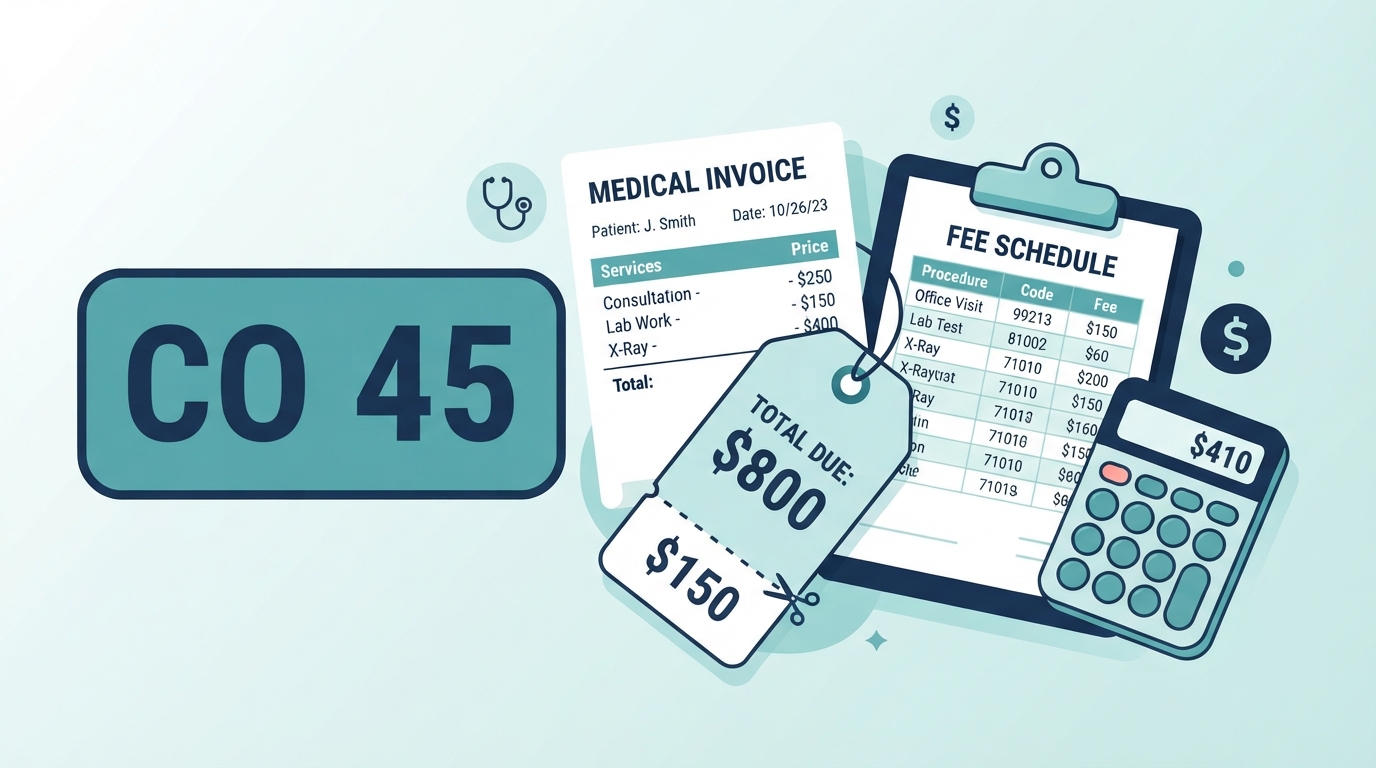
CO 45 means "charge exceeds fee schedule/maximum allowable or contracted/legislated fee arrangement." In plain English: you billed more than the payer's allowed amount for that service, and the difference is being adjusted off. With the CO (contractual obligation) group code, that difference is the practice's write-off. It cannot be billed to the patient.
CO 45 at a Glance
| Question | Answer |
|---|---|
| Is it a true denial? | No. It's a payment adjustment; the claim usually still pays the allowed amount. |
| Can you bill the patient for it? | No. CO adjustments are contractual write-offs for in-network providers. |
| Is it appealable? | Not normally. But it is auditable, and audits find money. |
| Where it appears | On nearly every in-network ERA, alongside the payment. |
Why CO 45 Shows Up
- Normal contract math. Your standard charge is higher than the contracted rate (it should be), so every paid claim carries a CO 45 adjustment for the difference. This is expected.
- Your fee schedule is loaded wrong. If charges are set below the payer's allowed amounts, you get paid your (lower) charge instead of the full allowable. The remittance looks clean, and you lose money silently on every claim.
- The payer's allowed amount is wrong. Payers misload contracts too. If the CO 45 adjustment is bigger than your contract says it should be, you're being underpaid.
- Out-of-network claims processed at in-network rates. The group code and adjustment may be misapplied; these deserve review rather than automatic posting.
How to Work CO 45 Correctly
- Post it against the contract, not against the remittance. Payment posting should compare the payer's allowed amount to your loaded contract rate for that CPT code. Any gap is an underpayment to recover, not a write-off.
- Audit your charge master yearly. Set charges comfortably above your highest contracted rate so you never leave allowable on the table.
- Trend it by payer. A payer whose effective collection ratio drifts down quarter over quarter is a payer whose fee schedule or claim edits changed. Catch it in the monthly numbers.
The Bottom Line
CO 45 is only "routine" when someone is checking the math. Practices that post remittances without contract comparison lose real revenue to silent underpayments every month. Our billing service reconciles every payment against contracted rates and flags underpayments for recovery, and our billing audit is the fastest way to find out what the last year of CO 45 postings actually cost you.
Related reading: the complete denial codes list, CO 16 explained, and CO 253 (sequestration) explained.
Ready to Grow Your Practice?
Let Astral Medical Billing handle your revenue cycle and digital marketing.
Contact Us Today