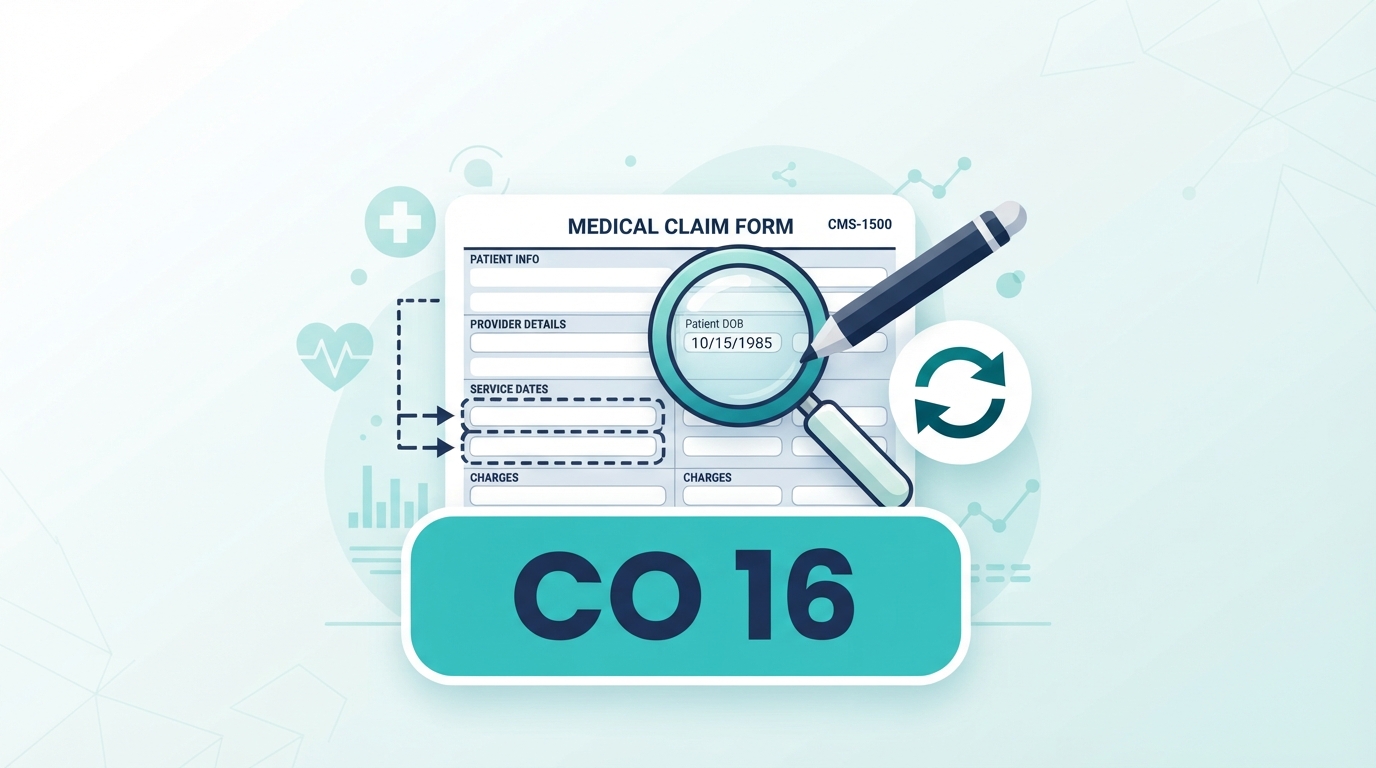
CO 16 reads "claim/service lacks information or has submission/billing error(s) which is needed for adjudication." The payer isn't judging the medicine or the medical necessity; it's telling you the claim as submitted can't even be processed. Something is missing, invalid, or malformed.
CO 16 at a Glance
| Question | Answer |
|---|---|
| Is it a true denial? | Technically yes, but it's really a rejection for missing data. |
| Should you appeal it? | No. Fix the claim and resubmit. Appeals are for judgment calls; CO 16 is a data problem. |
| Where's the actual reason? | In the accompanying RARC remark code (N or M code). CO 16 almost never travels alone. |
| Biggest risk | Letting corrected claims age past the timely filing deadline. |
Always Read the Remark Code
CO 16 is a category, not a diagnosis. The paired RARC tells you the exact missing element, and three account for most of what practices see: M76 (diagnosis code missing, invalid, or not specific enough), N290 (rendering provider identifier missing or invalid), and MA04 (secondary claim missing the primary payer's information). Common pairings:
| Remark code | What's missing or wrong |
|---|---|
| N290 / N257 | Rendering or billing provider identifier (NPI) missing or invalid |
| N265 / N286 | Ordering or referring provider information missing or invalid |
| M76 / M81 | Diagnosis code missing, invalid, or not coded to required specificity |
| N56 / M51 | Procedure code invalid or missing for the date of service |
| N382 | Patient identifier (member ID) missing or invalid |
| MA04 | Secondary claim missing primary payer information (EOB/COB data) |
| MA120 / MA121 | CLIA number missing or invalid on lab claims |
The Fix-and-Resubmit Workflow
- Match the RARC to the field. The remark code maps to a specific claim element; correct that element, don't guess.
- Fix the source, not just the claim. If the referring NPI was missing, update the patient record and the intake process so the next fifty claims don't repeat it.
- Resubmit as a corrected claim promptly. The original denial doesn't stop the timely filing clock with most payers. CO 16 denials that sit in a queue become permanent write-offs via CO 29.
- Trend your CO 16 remark codes monthly. The distribution tells you exactly which registration or charge-entry step is broken.
Prevention: This Denial Should Barely Exist
CO 16 is the most preventable code in the book. Complete registration data, real-time eligibility verification, and claim scrubbing that validates identifiers, diagnosis specificity, and payer-specific required fields will catch nearly all of it before submission. Practices with a 95%+ clean claim rate see CO 16 rarely; practices drowning in it have a front-end process problem that no amount of back-end rework will outrun. That front-to-back fix is what our denial management service delivers.
More from the library: the complete denial codes list, CO 236, and PR 119.
Ready to Grow Your Practice?
Let Astral Medical Billing handle your revenue cycle and digital marketing.
Contact Us Today