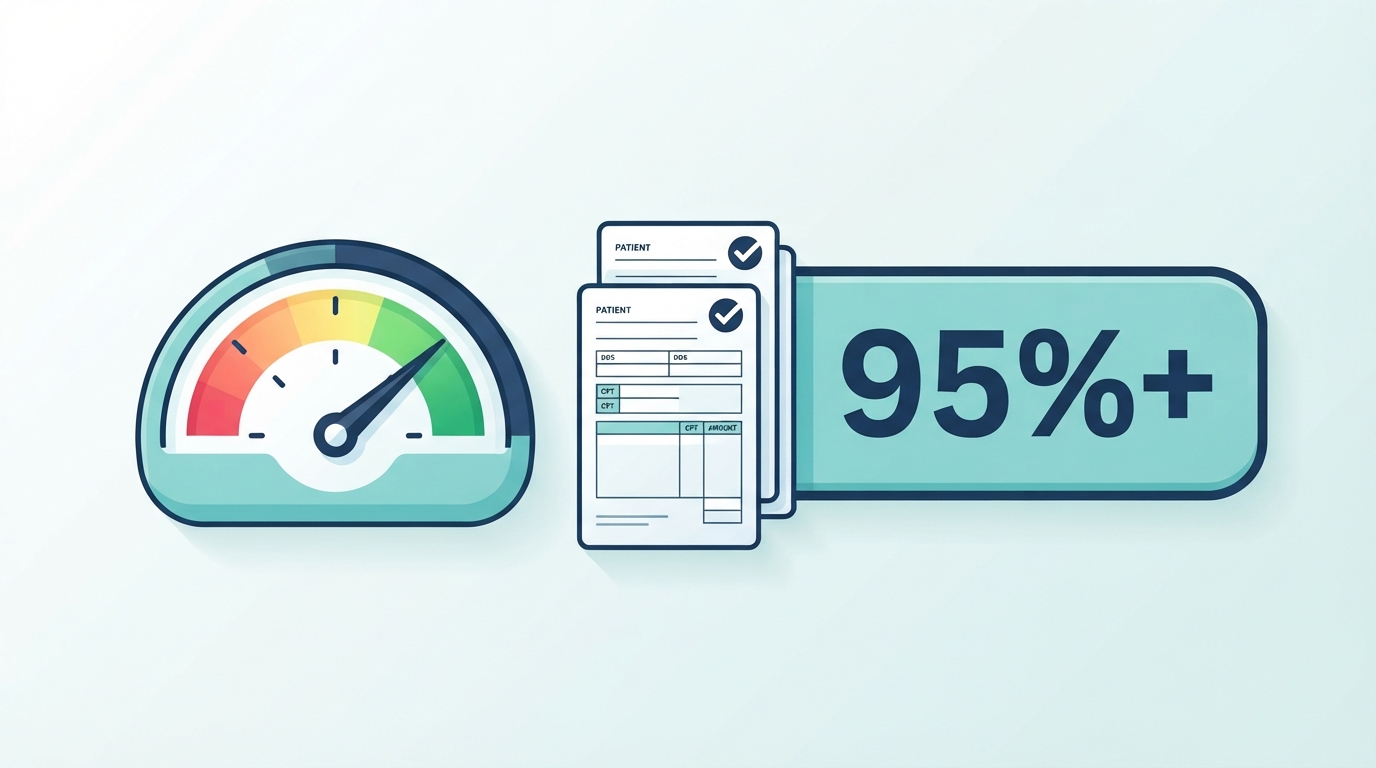
Quick answer: a good clean claim rate in 2026 is 95% or higher. Top-performing billing operations run 98-99%. The industry average across practices is meaningfully lower, with many small practices sitting in the 75-85% range without knowing it, because nobody is measuring.
What Counts as a Clean Claim
A clean claim is accepted and paid on first submission: no rejection at the clearinghouse, no denial at the payer, no requests for more information, no rework. The rate is simply clean claims divided by total claims submitted. We break down the formula and measurement details in our clean claim rate guide; this post is about benchmarks and what the gaps cost.
Clean Claim Rate Benchmarks (2026)
| Tier | Clean Claim Rate | What It Means |
|---|---|---|
| Top performers | 98-99% | Dedicated scrubbing, eligibility checks on every visit, denial root-cause feedback loop |
| Healthy benchmark | 95-98% | The standard every practice should hold its billing to |
| Needs attention | 90-95% | Real money in rework; usually one or two fixable root causes |
| Revenue emergency | Below 90% | 1 in 10+ claims needs rework or dies; collections and cash flow are both suffering |
What Each Percentage Point Is Worth
Reworking a rejected or denied claim costs a practice roughly $25 in staff time per claim, and a meaningful share of denied claims never get reworked at all. For a practice submitting 1,000 claims a month, the difference between 85% and 95% clean is 100 claims a month: about $2,500 in monthly rework labor, plus the 5-15% of those claims that quietly become write-offs, plus 2 to 6 weeks of added delay on every reworked dollar. A single point of clean claim rate is worth real money at any volume.
Why Claims Fail on First Pass
- Eligibility and registration errors: inactive coverage, wrong plan, typos in subscriber data. The single biggest category, and the most preventable one. This is the source of most CO 16 and PR 27 denials.
- Coding issues: missing modifiers, diagnosis codes that don't support the procedure, NCCI edit conflicts like CO 236.
- Missing authorizations: the service was performed before the payer approved it.
- Payer-specific rules: place-of-service codes, taxonomy requirements, and format quirks that differ plan to plan.
- Timely filing: claims submitted late fail permanently (CO 29).
How to Get Above 95%
- Verify eligibility on every visit, not just new patients. Coverage changes mid-year constantly.
- Scrub claims against payer rules and current NCCI edits before submission, not after denial.
- Track your rejections by reason code monthly. The distribution tells you which front-end step is broken; fix the step, not just the claim.
- Close the loop. Every denial should change something upstream: a registration field, a coding habit, an authorization workflow. That feedback loop is the difference between 90% and 98%, and it's the core of our denial management service.
Measure Yours Right Now
Use the calculator below: enter your submitted and clean claim counts and see which tier you land in. If you're under 95%, our billing service holds itself to that benchmark contractually, and reports it to you monthly.
Clean Claim Rate Calculator
Enter your numbers to see how your first-pass clean claim rate stacks up against the industry benchmarks.
Your Clean Claim Rate
—
Enter your claim numbers to see your clean claim rate.- Below 90% — needs improvement
- 90–95% — on benchmark
- 95%+ — strong
Ready to Grow Your Practice?
Let Astral Medical Billing handle your revenue cycle and digital marketing.
Contact Us Today